
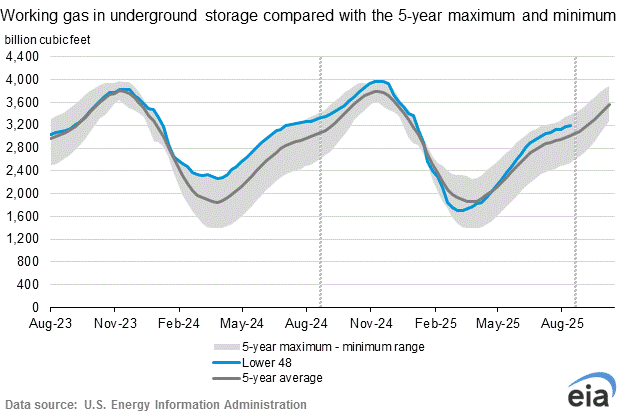
Natural gas supply going into this winter looks comfortable. The EIA expects storage to enter the heating season about 2% above the five-year average (not a comforting amount) and the agency now projects Henry Hub to average under $3 per MMBtu in 2027. The prompt month contract traded between roughly $2.60 and $3.30 through October. If you have been waiting for some relief on energy costs, this feels like it.
All it takes is one cold snap to erase any cost savings
What did last January teach us?
Texas just had its warmest winter on record, and it still included four days of extreme cold from January 24-27. Dallas hit 13°F and Houston 23°F. This even shut in about 18 Bcf/d of gas production at its peak, storage withdrawals set records, and the EIA raised its near-term price forecast by 40% in a single month. Henry Hub futures climbed above $4.20 before falling nearly a dollar by spring.
ERCOT stayed reliable throughout and was the only region where the storm pushed forward power prices down instead of up. That's good news, but it shouldn't change your buying decisions. A mild winter can still have a few brutal days, and those days are where the price risk lives. If you buy on an index and haven't hedged then you are exposed to those few days which could be costly. This is a conservative viewpoint but GTI Energy Advisors treats our clients' money like our own and recommends what we would do if in their shoes.
What does this winter look like?
ERCOT's preliminary outlook calls for slightly to moderately above normal temperatures, with one of the three strongest El Niño patterns on record bringing a wetter trend. Strong El Niño winters have a track record in Texas that point toward mild rather than cold. The two closest comparisons to this year’s event were in 1997-98 and 2015-16. Both winters ran warm overall, since a stronger jet stream parked across the Gulf South tends to bring more moisture and storms but blocks the Arctic air intrusions that cause the worst Texas cold snaps. Winter Storm Uri in 2021 happened during a La Niña winter, not an El Niño, and La Niña is the pattern historically tied to the deep, sustained freezes that do real damage. That doesn’t mean El Niño winters are risk free, Texas has still seen snow and ice events during strong El Niño years, just from a wetter storm track rather than a polar outbreak. The takeaway is that this year’s pattern tilts the odds toward mild, not that it rules out a bad week.
LNG feedgas hit a new daily record on November 7 and the EIA expects gross LNG exports to climb from 15 Bcf/d in 2025 to 18 this year and 19 in 2027. That is gas competing with your heating load for the same supply. On the power side, the EIA expects wholesale electricity to average $52 per MWh this year, up 11% from 2025, and commercial and industrial demand to grow close to 3% in 2027. Winter reserve margins in ERCOT are also thinner than they were in 2021, because peak demand has grown faster than firm generation.
Why do the holidays matter for your contract?

Happy Thanksgiving from all of us at GTI Energy Advisors.
If you have an indexed contract (index, load following, or block) with unhedged volumes you are exposed to any price spikes.
The opposite risk is real as well. If you are on an index and a cold front arrives the week your team is off, you have exposure at the exact moment nobody is watching it.
Thanksgiving week is a short trading week and suppliers and utilities run with thin staffing, so if you have any trades to make do so before 3:00pm ET Tuesday.
So what should you do before the first cold front?
- Read the swing, bandwidth and imbalance terms in your contract and compare them with your holiday schedule.
- Give your supplier or advisor your shutdown dates so volumes and nominations reflect what you will actually use.
- If you buy on an index, decide how much cold snap exposure you can live with and put a fixed layer or a price cap in place before January.
- Review your demand charge and ratchet terms, and any peak response commitments you have signed.
- Test your backup generation. Run it under load, check the fuel and confirm the transfer switch works. After last January, this is no longer a nice to have. GTI Energy Advisors are happy to help you with innovative backup solutions.
- Start your 2027 and 2028 renewal work now and buy in layers, so you are not forced to make one large decision on a bad day.
A word on timing: We can't tell you where prices go from here, and nobody honestly can. What we can tell you is that buying in a calm market gives you better options than buying in the middle of a storm. Prices are soft right now, and that window won't last forever.
Where GTI Energy Advisors fits in
We spend this time of year helping clients line up their holiday volumes, check their contract language and decide how much winter risk they want to carry. If you want a second set of eyes before the cold arrives, reach out to us.
A mild winter still has a few bad days, and those are the days that set your bill.